
For nearly a decade, Conservation Minnesota has worked to provide opportunities for community leaders, staff liaisons, and volunteer advisory commissioners who serve on city environmental, sustainability, or natural resources commissions to connect across borders and learn from colleagues and experts. In partnership with GreenStep Cities & Tribal Nations, this year’s forum focused on community engagement efforts and the impacts of hazardous air quality. We heard from the Minnesota Pollution Control Agency (MPCA) and the Minnesota Department of Health (MDH) about human health impacts from wildfire smoke and what guidance is available for local governments to respond, the City of Buffalo about their Great Outdoors Fair, and held a panel discussion with the Cities of Chanhassen, Mendota Heights, and Plymouth about their environmental academies and sustainable business programs.
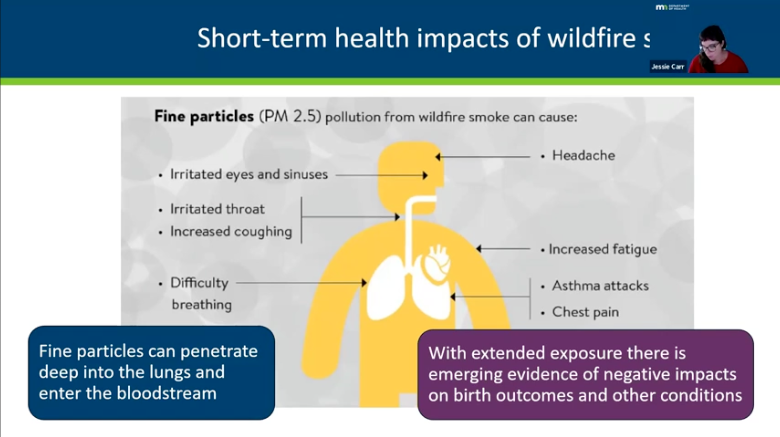
Dr. Jessie Carr, Environmental Epidemiologist Supervisor with the MDH, and Ryan Lueck, MPCA Air Quality Meteorologist, kicked off the forum with a presentation about the health impacts of wildfire smoke. They talked about the air quality index (AQI), which measures pollutants like fine particles, ground-level ozone, sulfur dioxide, nitrogen dioxide, and carbon monoxide. Wildfire smoke creates fine particle pollution that can induce asthma attacks and difficulty breathing for some people with heart and lung conditions, but long-term exposure and unhealthy and hazardous air quality events can negatively impact anyone. Those who vigorously exercise outdoors, outdoor workers, older adults, babies, and children can all experience intensified impacts when exposed to wildfire smoke. Just this summer, Minnesota saw record breaking hazardous AQI levels caused by the fires in the Boundary Waters in northern Minnesota. Data from this smoke event showed that respiratory emergency room visits were 6% higher statewide, and 28% higher in the northeast region of the state compared to non-smoke weeks.
Carr and Lueck also highlighted the Smoke Ready Campaign, which provides guidance on how Minnesotans should respond to hazardous and unhealthy air alerts, including when to seek medical treatment. It starts by knowing your risk and the risk of your family, checking the air quality, and considering changing outdoor plans like rescheduling a workout or moving an event inside.
Next, we heard from Beth Opheim and Cara Hesse from the City of Buffalo about their work organizing and growing the Great Outdoor Fair over the last two years. The Great Outdoor Fair is a free family event that offers opportunities for the community to learn skills like archery and backyard homesteading among live music and food vendors. The fair was born from a desire to have Earth Day events and connect with area schools around water conservation. Through outreach to partners like Wright County, the Department of Natural Resources, and the University of Minnesota Extension, they learned they all shared the goal of creating an educational, free, and fun conservation themed event for the community. If you’re ever near Buffalo in September, make sure to stop by the fair!
Lastly, Avery Hildebrand, Conservation Minnesota’s Public Engagement Program Manager, moderated a panel discussion with Jamie Marsh from the City of Chanhassen representing their Environmental Academy, Courtney Selstad from the City of Mendota Heights representing their Sustainable Business Program, and MK Anderson with the City of Plymouth representing their Stewardship Academy. The panel discussed the successes and challenges of these programs that aim to provide tools for community members and businesses to act on sustainability, energy conservation, and environmental impact. Some of the programming offered by the academies in Chanhassen and Plymouth include tours of area parks and recycling centers, classes on invasive species and pollinator gardens, and ways that residents can make impactful changes in their own homes and yards. The Sustainable Business Program in Mendota Heights seeks to elevate and celebrate local businesses and organizations that act on three pillars of sustainability—nature, energy, and waste—through public recognition from the city and access to free resources that help to support and advance sustainable business practices. These programs and academies are also a way for their environmental and natural resources commissions to help connect with the community and advance local stewardship goals.
Throughout the forum, we talked about how wildfire smoke and poor air quality were impacting these efforts and events, and our own daily lives.
We appreciate the work that local volunteer commissioners and city staff do each day to help build community and improve their local environment. Conservation Minnesota will continue to provide opportunities for environment commissions and commissioners to connect across borders, foster ideas, and build community.